

11 Oct, 2026
Vishal Mega Mart Shares Jump 10%: Why Gunender Kapur’s Reappointment Has Investors Excited
When people think about successful startups, they often imagine software companies, groundbreaking technology, or entrepreneurs backed by millions in venture capital. Yet some of the most inspiring businesses are built far away from boardrooms and investment firms.
The Junk Teens success story proves exactly that.
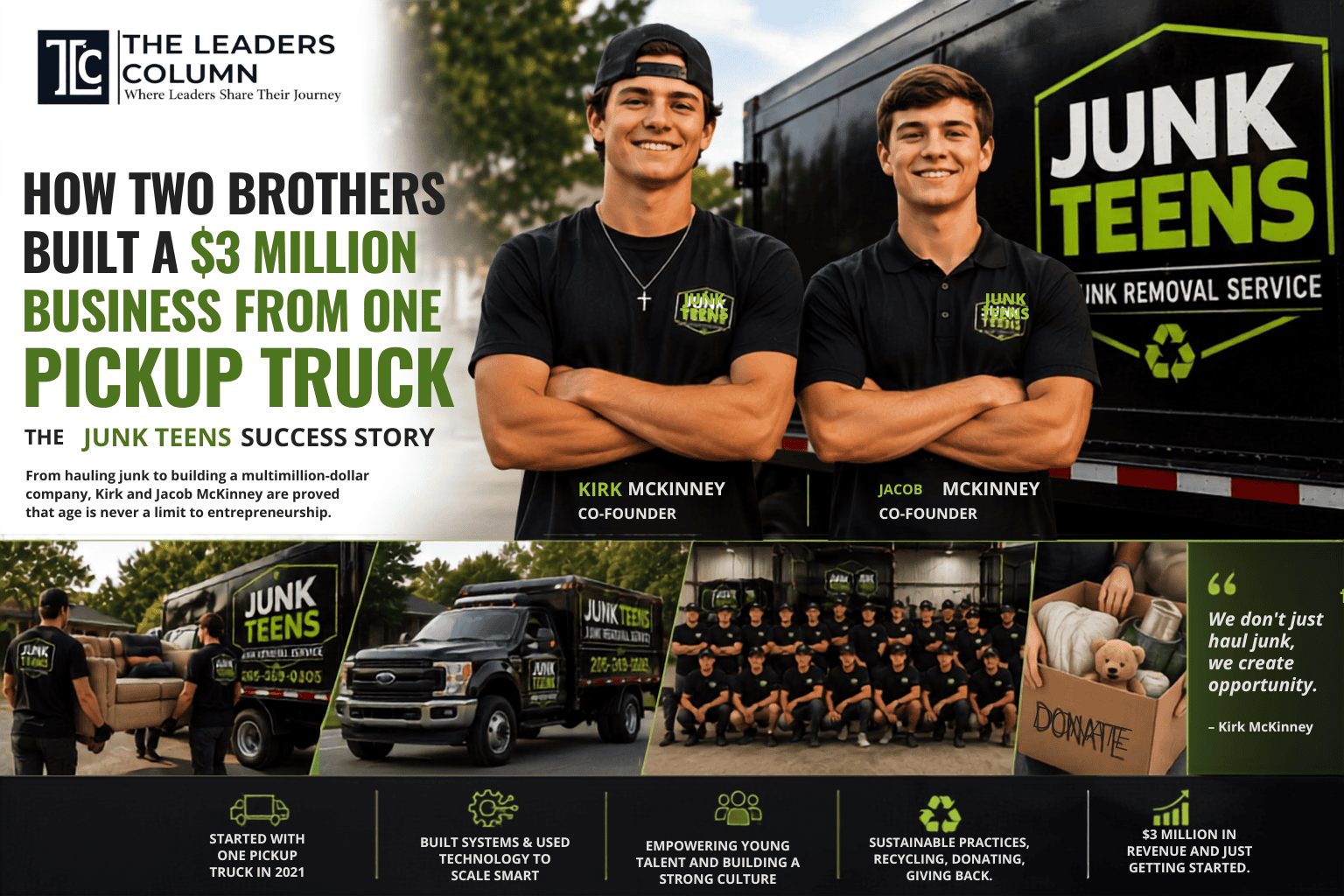
Brothers Kirk McKinney and Jacob McKinney didn’t invent a revolutionary app or launch the next social media platform. Instead, they built a thriving business by solving an everyday problem that millions of homeowners face, removing unwanted junk quickly, responsibly, and professionally.
What began in 2021 with a single pickup truck has grown into a company generating $3 million in annual revenue, employing dozens of young people, and serving multiple communities across New England. Their journey is not just about financial success; it is about leadership, innovation, sustainability, and the changing face of entrepreneurship.
At a time when many young professionals are questioning traditional career paths, the McKinney brothers have shown that success isn’t determined by the industry you enter, it is determined by how creatively and consistently you execute your vision.

Turning an Everyday Problem into a Business Opportunity
Every successful entrepreneur has one thing in common: they identify opportunities where others only see routine challenges.
For Kirk and Jacob, that opportunity came through junk removal.
While many people viewed discarded furniture, appliances, and household clutter as nothing more than waste, the brothers saw an industry filled with untapped potential. They recognized that homeowners were willing to pay for convenience, while many discarded items still carried resale or donation value.
Their business began with one pickup truck, determination, and a willingness to do work that many others overlooked.
One early experience shaped the company’s future.
During a cleanup job, the brothers found a pair of functioning speakers that had been thrown away. Instead of sending them to a landfill, they sold them through an online marketplace, earning their first taste of additional revenue beyond junk removal.
That simple discovery sparked a larger realization.
Waste often isn’t waste at all.
From that point forward, the company incorporated recycling, donations, and resale into its business model whenever possible. This approach created additional income streams while reducing landfill waste and providing greater value to local communities.
Today, environmental responsibility remains one of the defining characteristics of the Junk Teens brand.
Building More Than Revenue, Building Trust
One of the biggest reasons behind the company’s rapid growth has been its commitment to customer experience.
Unlike many service businesses that focus solely on completing jobs, Junk Teens invested heavily in professionalism, reliability, and transparent communication from the very beginning.
Customers weren’t simply paying someone to haul away unwanted items.
They were trusting a team to enter their homes, handle valuable belongings, and complete the work efficiently.
By consistently delivering dependable service, the company earned referrals, repeat business, and positive online reviews that fueled organic growth far more effectively than expensive advertising campaigns.
In today’s digital economy, trust has become one of the most valuable business assets.
The McKinney brothers understood that exceptional service creates marketing opportunities that no advertising budget can replicate.
Why Systems Matter More Than Hustle
Many entrepreneurs believe working longer hours is the secret to scaling a business.
The Junk Teens success story demonstrates the opposite.
As demand increased, Jacob found himself managing employee schedules, organizing pickup routes, coordinating logistics, and overseeing day-to-day operations. Long workdays became the norm, leaving little time for strategic planning or business development.
Like many founders, he had unknowingly become the company’s biggest operational bottleneck.
Recognizing this challenge required an important shift in mindset.
Instead of trying to do everything themselves, the brothers began building systems that allowed the business to operate independently of its founders.
Responsibilities were divided among trusted team members.
Experienced employees stepped into management roles.
Daily operations became standardized.
Clear processes replaced constant improvisation.
This transformation allowed the founders to focus on growing the business instead of merely running it.
It’s one of the most valuable lessons for entrepreneurs: sustainable companies are built on repeatable systems, not founder burnout.
The Power of Young Leadership
One aspect that makes Junk Teens unique is the age of its leadership team.
Rather than viewing youth as a disadvantage, the McKinney brothers turned it into one of their greatest strengths.
Their company employs many high school and college students, creating opportunities for young people to develop practical skills while earning competitive wages.
More importantly, employees aren’t treated as temporary workers.
They’re encouraged to take ownership, solve problems, contribute ideas, and grow alongside the company.
This culture creates an environment where innovation happens naturally.
Young employees often bring fresh perspectives, high energy, and a willingness to embrace new technology, qualities that help businesses adapt more quickly to changing markets.
As the company expands, employees gain access to leadership opportunities that many organizations reserve for far more experienced professionals.
That sense of shared growth has become a defining feature of the company’s culture.
How Technology Helped Scale a Traditional Business
The junk removal industry may seem traditional, but the McKinney brothers have embraced modern technology to improve efficiency across nearly every aspect of their operations.
In the early days, scheduling jobs and coordinating employees relied heavily on simple digital notes and manual communication.
As customer demand increased, that approach quickly became unsustainable.
The company invested in customer relationship management software, employee management platforms, and workflow automation tools that streamlined operations while improving the customer experience.
Technology eliminated repetitive administrative work and allowed employees to focus on delivering better service.
Artificial intelligence has also become part of the company’s operational strategy.
Rather than replacing people, AI supports decision-making, improves organization, and helps teams work more efficiently.
Perhaps the most remarkable innovation came from one of the company’s own employees.
Using AI-assisted software development tools, a teenage team member created a custom application that tracks employee performance, monitors productivity, and provides real-time operational insights.
Only a few years ago, developing custom software required large development teams and significant investment.
Today, AI has made software creation more accessible than ever.
The Junk Teens success story demonstrates that innovation isn’t reserved for technology companies.
Turning Social Media Into a Growth Engine
The growth of Junk Teens was not built only through hard work, it was also powered by storytelling.
Founders Kirk and Jacob McKinney understood that people connect with people, not just services. Instead of depending only on traditional advertising, they used social media to showcase the real journey behind their business.
From daily operations and team moments to customer experiences and unexpected discoveries, their content gave audiences an authentic look into the company. This helped transform Junk Teens from a local service provider into a recognizable brand.
Beyond attracting customers, social media also became a powerful recruitment tool. Young professionals and students could see the company culture before joining, making it easier to attract motivated team members who shared the founders’ vision.
Building a Culture That Empowers Young Talent
One of the strongest elements of the Junk Teens success story is its focus on people.
The company has created opportunities for high school and college students to gain practical work experience, develop professional skills, and grow within the organization.
Rather than treating employees as temporary workers, Kirk and Jacob encourage ownership and responsibility. Team members are given opportunities to improve processes, develop leadership skills, and contribute to the company’s growth.
This people-first approach has helped create a motivated workforce where employees feel connected to the mission of the business.
A strong culture has become one of the company’s biggest advantages, proving that investing in people can be just as valuable as investing in technology.
Creating Impact Beyond Revenue
For Junk Teens, success is not only measured by financial growth.
The company focuses on responsible disposal by donating, recycling, and repurposing items whenever possible. This approach reduces waste while creating positive impact within local communities.
By combining business growth with social responsibility, the company demonstrates how modern entrepreneurs can build profitable businesses while contributing to a larger purpose.
Leadership Lessons From the Founders
The Junk Teens journey offers important lessons for entrepreneurs:
Start with what you have: Great businesses can begin with simple resources and a clear purpose.
Build systems early: Growth becomes possible when founders create processes and empower teams.
Use technology wisely: AI and digital tools can help traditional businesses become more efficient.
Invest in people: A strong team creates long-term success.
Frequently Asked Questions
How did Junk Teens start?
Junk Teens began in 2021 with one pickup truck when brothers Kirk and Jacob McKinney identified an opportunity in junk removal and recycling.
What makes Junk Teens different?
The company combines traditional services with technology, social media marketing, sustainability, and a strong employee-focused culture.
What can entrepreneurs learn from Junk Teens?
Their story shows the importance of taking action, adapting quickly, building systems, and creating value for customers and communities.
The Future of Entrepreneurship
The Junk Teens success story represents a new era of entrepreneurship where traditional industries are being transformed through innovation, technology, and strong leadership.
The brothers proved that a business does not need to start with millions in funding or a revolutionary invention. It can begin with a simple idea, consistent execution, and the courage to take the first step.
From a single pickup truck to a multimillion-dollar company, their journey is a reminder that opportunities exist everywhere for entrepreneurs willing to see problems differently and build solutions with purpose.







Leave a Comment