

10 Sep, 2026
How Growmax Is Helping Dubai’s Local Businesses Win Online
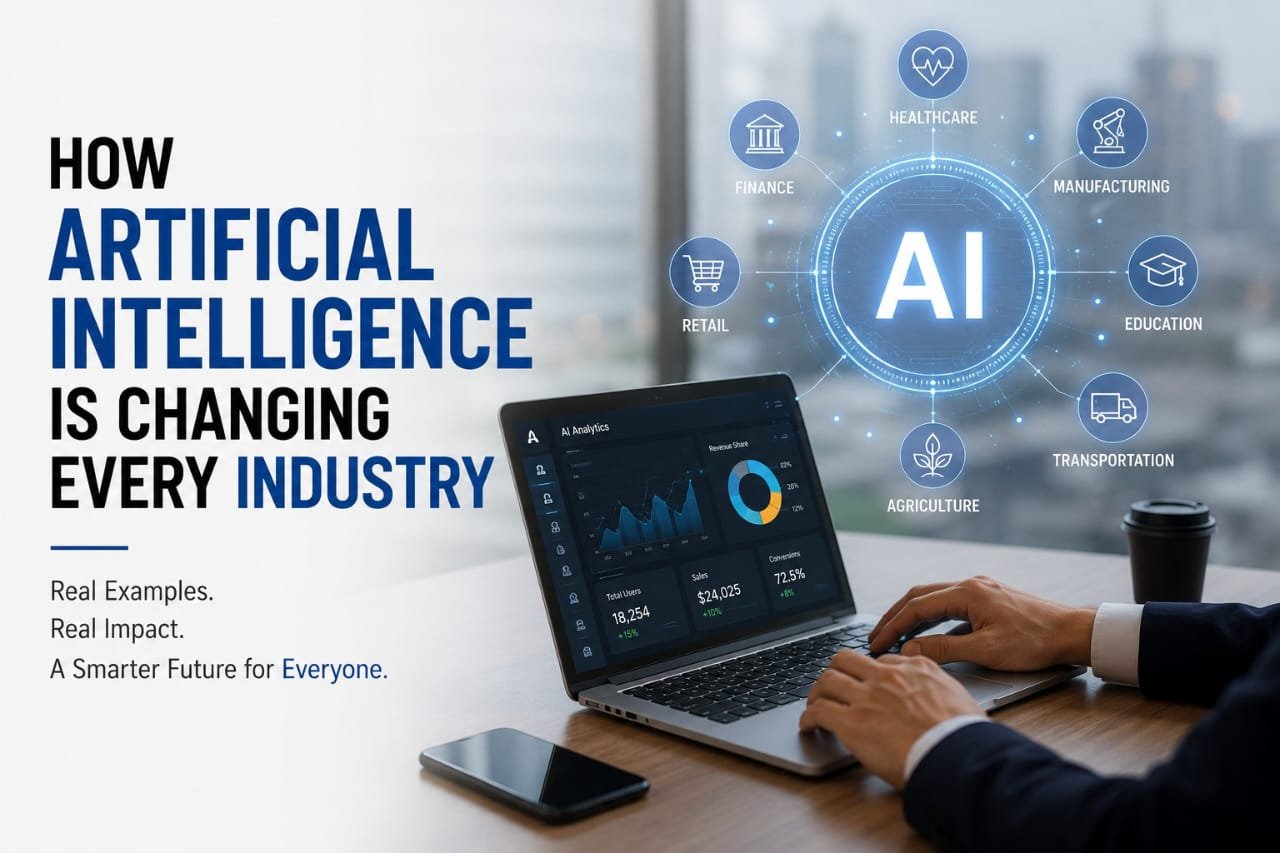
Artificial Intelligence (AI) is no longer a futuristic concept, it has become one of the most transformative technologies of our time. From healthcare and finance to retail, manufacturing, education, and transportation, AI is revolutionizing the way organizations operate, make decisions, and serve customers.
Businesses worldwide are investing billions of dollars in AI-driven technologies to improve efficiency, reduce operational costs, automate repetitive tasks, and deliver personalized customer experiences. As AI continues to evolve in 2026, its influence is expanding across virtually every industry.
Whether you’re a business leader, entrepreneur, technology enthusiast, or professional looking to understand the future of work, knowing how Artificial Intelligence is reshaping industries is essential.
What Is Artificial Intelligence?
Artificial Intelligence refers to computer systems capable of performing tasks that typically require human intelligence. These tasks include learning, reasoning, problem-solving, language understanding, decision-making, and recognizing patterns in data.
Modern AI combines machine learning, deep learning, natural language processing (NLP), computer vision, and predictive analytics to solve complex business challenges.
Today, AI powers everything from virtual assistants and recommendation engines to autonomous vehicles and intelligent business software.
Why Artificial Intelligence Matters More Than Ever
Organizations across the globe are embracing AI because it offers measurable business benefits.
Some of the biggest advantages include:
– Improved productivity
– Faster decision-making
– Lower operational costs
– Enhanced customer experiences
– Better data analysis
– Increased business efficiency
– Smarter automation
– Competitive advantage
Companies that strategically adopt AI are better positioned to innovate and respond to rapidly changing market demands.
AI in Healthcare
Healthcare is one of the industries experiencing the most significant transformation through Artificial Intelligence.
AI assists healthcare professionals by analyzing medical images, identifying diseases, predicting patient outcomes, and supporting personalized treatment plans.
How AI Is Improving Healthcare
– Early disease detection
– Medical image analysis
– Drug discovery
– Virtual health assistants
– Personalized treatment recommendations
– Predictive patient monitoring
Hospitals and healthcare providers are increasingly using AI to improve patient care while reducing costs and administrative workloads.
AI in Finance
Financial institutions are leveraging AI to improve security, detect fraud, automate processes, and deliver personalized financial services.
Banks and fintech companies use AI-powered algorithms to analyze transactions in real time, helping prevent fraudulent activities before they occur.
AI Applications in Finance
– Fraud detection
– Credit risk assessment
– Algorithmic trading
– Personalized banking
– Investment analysis
– Customer support chatbots
AI is enabling financial organizations to make smarter decisions while enhancing customer trust and operational efficiency.
AI in Retail and E-Commerce
Retail businesses are using Artificial Intelligence to better understand customer preferences and create highly personalized shopping experiences.
AI analyzes browsing behavior, purchase history, and customer interactions to recommend products that customers are most likely to buy.
Benefits for Retailers
– Personalized recommendations
– Inventory optimization
– Demand forecasting
– Dynamic pricing
– Customer service automation
– Supply chain optimization
Leading retailers are using AI to improve customer satisfaction while increasing revenue and reducing waste.
AI in Manufacturing
Manufacturers are embracing AI-powered automation to increase productivity, improve quality control, and reduce equipment downtime.
Predictive maintenance allows companies to identify potential equipment failures before they happen, minimizing production interruptions.
Manufacturing Applications
– Predictive maintenance
– Industrial automation
– Robotics
– Quality inspection
– Supply chain optimization
– Production forecasting
Smart factories powered by AI are setting new standards for efficiency and operational excellence.
AI in Education
Artificial Intelligence is reshaping education by making learning more personalized and accessible.
Educational institutions use AI to adapt learning materials according to each student’s progress, strengths, and challenges.
AI Benefits in Education
– Personalized learning
– Intelligent tutoring systems
– Automated grading
– Learning analytics
– Virtual classrooms
– Language translation
AI helps educators spend more time teaching while reducing administrative workloads.
AI in Marketing
Marketing has become one of the fastest-growing applications of Artificial Intelligence.
Businesses use AI to analyze customer behavior, optimize campaigns, generate content, and improve advertising performance.
AI Marketing Applications
– Customer segmentation
– Content generation
– Email personalization
– Predictive analytics
– Chatbots
– Social media optimization
AI enables marketers to create more targeted campaigns while maximizing return on investment.
AI in Customer Service
Modern customer service relies heavily on AI-powered chatbots and virtual assistants.
These intelligent systems provide instant support, answer common questions, and resolve customer issues around the clock.
Business Benefits
– 24/7 customer support
– Reduced response times
– Higher customer satisfaction
– Lower support costs
– Improved service consistency
AI allows businesses to deliver faster and more efficient customer experiences.
AI in Transportation and Logistics
Transportation companies are using AI to optimize routes, predict maintenance needs, and improve fleet management.
Logistics providers use AI to forecast demand, reduce delivery times, and enhance supply chain visibility.
Key applications include:
– Route optimization
– Autonomous vehicles
– Fleet management
– Warehouse automation
– Delivery forecasting
– Fuel efficiency optimization
AI is making transportation smarter, faster, and more sustainable.
How Artificial Intelligence Is Changing Every Industry in 2026 (Part 2)
AI in Cybersecurity
As cyber threats become more sophisticated, Artificial Intelligence is playing a crucial role in protecting businesses and individuals. AI-powered cybersecurity solutions can monitor networks in real time, detect unusual behavior, and respond to threats much faster than traditional systems.
Key Applications
– Real-time threat detection
– Malware identification
– Fraud prevention
– Identity verification
– Automated incident response
– Network monitoring
Organizations are increasingly using AI to strengthen their security posture and reduce the risk of cyberattacks.
AI in Human Resources
Human Resources (HR) teams are leveraging AI to streamline recruitment, employee engagement, and workforce planning.
AI-powered recruitment platforms can analyze resumes, match candidates with job requirements, and automate interview scheduling, allowing recruiters to focus on strategic hiring decisions.
Benefits of AI in HR
– Resume screening
– Talent acquisition
– Employee performance analysis
– Learning and development
– Workforce planning
– HR automation
AI is helping organizations hire faster while improving the overall employee experience.
AI in Agriculture
Artificial Intelligence is transforming agriculture by helping farmers increase productivity while reducing waste and environmental impact.
AI systems analyze weather conditions, soil quality, crop health, and irrigation needs, enabling more efficient farming practices.
AI Applications in Agriculture
– Precision farming
– Crop monitoring
– Smart irrigation
– Pest detection
– Yield prediction
– Livestock monitoring
These technologies help improve food production while promoting sustainable agriculture.
AI in Real Estate
The real estate industry is embracing AI to improve property valuation, customer service, and investment decisions.
AI analyzes market trends, buyer preferences, and property data to provide valuable insights for real estate professionals and investors.
Key Benefits
– Property valuation
– Market forecasting
– Lead generation
– Virtual property tours
– Customer relationship management
– Investment analysis
AI is making property transactions faster, smarter, and more data-driven.
Challenges of Artificial Intelligence
While AI offers enormous opportunities, businesses must also address several important challenges.
Data Privacy
AI systems rely heavily on data. Organizations must ensure customer information is collected, stored, and processed responsibly while complying with privacy regulations.
Cybersecurity Risks
As AI adoption grows, cybercriminals are also using AI to create more advanced attacks. Businesses need strong security strategies to protect sensitive information.
Workforce Transformation
AI is automating repetitive tasks, changing job roles rather than eliminating them entirely. Upskilling and continuous learning are becoming essential for employees.
Ethical AI
Organizations must ensure AI systems are transparent, fair, and free from bias. Responsible AI governance is becoming a key priority for businesses worldwide.
The Future of Artificial Intelligence
Artificial Intelligence is expected to become even more integrated into everyday business operations over the coming years.
Emerging trends include:
– Agentic AI capable of performing complex tasks autonomously
– AI-powered business assistants
– Hyper-personalized customer experiences
– Autonomous supply chains
– AI-driven decision intelligence
– Advanced robotics and automation
– Smarter healthcare diagnostics
– Predictive business analytics
Businesses that invest in AI today will be better prepared to compete in an increasingly digital economy.
How Businesses Can Prepare for the AI Revolution
To successfully adopt Artificial Intelligence, organizations should:
– Identify repetitive tasks suitable for automation.
– Invest in employee training and AI literacy.
– Maintain high-quality, secure data.
– Implement AI responsibly with clear governance policies.
– Combine AI with human expertise for better decision-making.
– Continuously evaluate AI performance and business impact.
Successful AI adoption is not just about technology, it requires the right strategy, people, and processes.
Final Thoughts
Artificial Intelligence is no longer limited to technology companies. It is transforming healthcare, finance, manufacturing, education, retail, agriculture, logistics, real estate, and nearly every other industry.
Businesses that embrace AI can improve productivity, reduce costs, deliver better customer experiences, and unlock new opportunities for innovation. At the same time, responsible implementation, ethical considerations, and continuous learning will remain essential.
As AI continues to evolve, organizations that adapt early will be better positioned to lead in the future. The question is no longer whether AI will change your industry, it is how quickly your business is prepared to evolve with it.
Frequently Asked Questions (FAQs)
What is Artificial Intelligence?
Artificial Intelligence (AI) is a branch of computer science that enables machines to perform tasks such as learning, reasoning, problem-solving, language understanding, and decision-making that typically require human intelligence.
Which industries benefit the most from AI?
Healthcare, finance, manufacturing, retail, education, logistics, agriculture, cybersecurity, real estate, and customer service are among the industries experiencing the greatest impact from AI adoption.
How does AI improve business productivity?
AI automates repetitive tasks, analyzes large volumes of data, improves decision-making, enhances customer service, and optimizes business processes, allowing employees to focus on higher-value work.
Is AI replacing human jobs?
AI is changing the nature of work by automating routine tasks. While some roles are evolving, AI is also creating new opportunities that require human creativity, critical thinking, and technical skills.
Why is AI important for businesses?
AI helps businesses become more efficient, reduce operational costs, improve customer experiences, increase revenue opportunities, and stay competitive in a rapidly changing digital landscape.






Leave a Comment