
10 Oct, 2026
Google Ads vs Facebook Ads: Which Advertising Platform Should Your Business Choose?
Every business looking to grow online faces a major marketing decision: where should it spend its advertising budget? The debate around Google Ads vs Facebook Ads continues because both platforms offer powerful ways to reach customers, but they work in completely different ways.
Imagine someone searching on Google for a solution to a problem they need to fix immediately. They are already interested and likely ready to make a purchase. Now imagine another person casually scrolling through Facebook and discovering a product through an attractive video or image that catches their attention. They were not searching for that product, but the advertisement created interest.
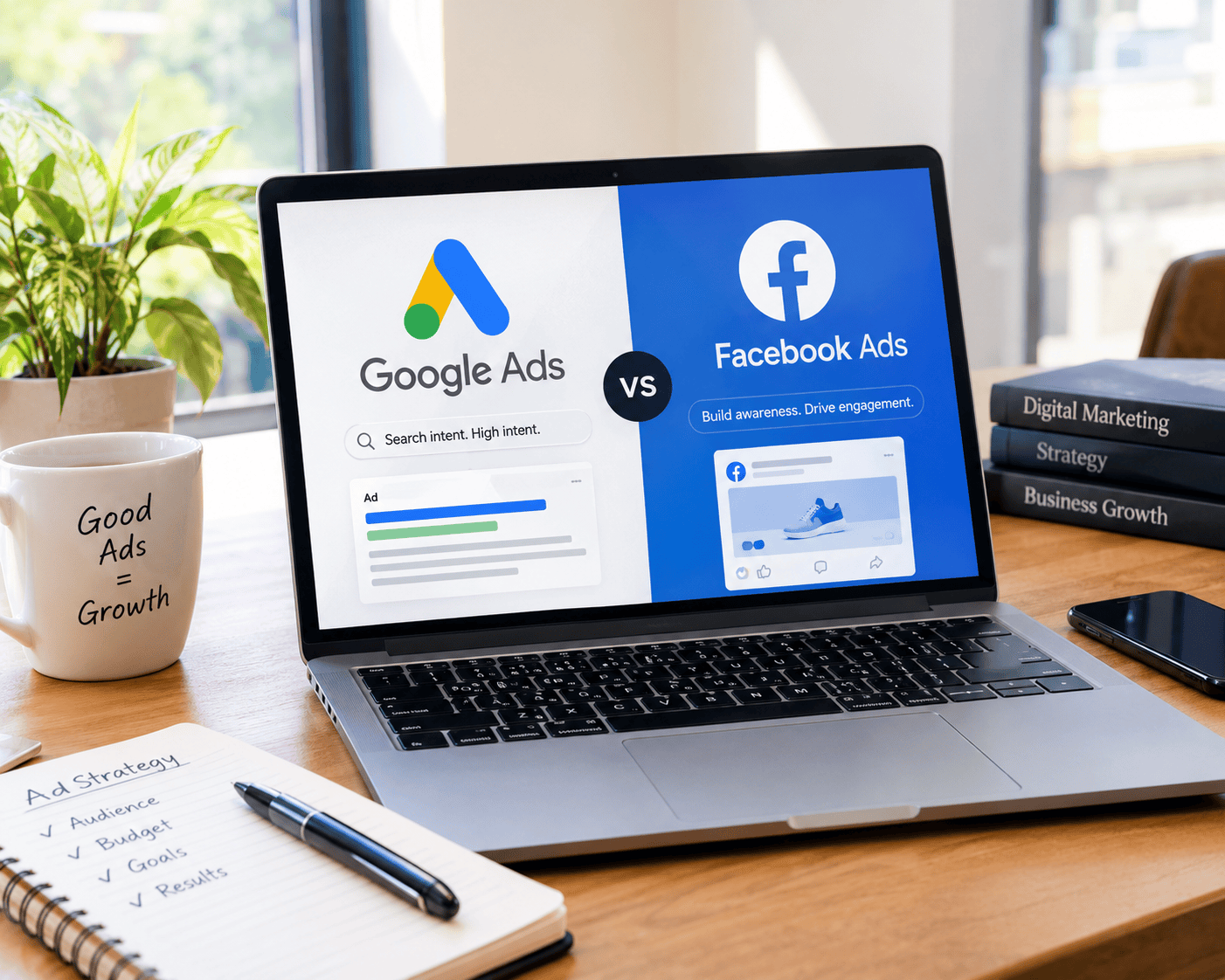
These two examples explain the fundamental difference between Google Ads and Facebook Ads. Google Ads focuses on capturing existing customer demand, while Facebook Ads focuses on creating new demand by introducing products and services to targeted audiences.
For businesses, choosing the right platform depends on their goals, industry, audience behaviour, and marketing strategy.
Google Ads vs Facebook Ads: Which Platform Performs Better?
When it comes to immediate sales and conversions, Google Ads often has an advantage because users are actively searching for solutions. A person typing a specific keyword into Google usually has stronger buying intent compared to someone browsing social media.
Facebook Ads, however, is highly effective for building brand awareness and reaching new customers. The platform allows businesses to target people based on interests, behaviour, demographics, and online activity.
For visually attractive products such as fashion, beauty, food, travel, and lifestyle products, Facebook Ads often delivers strong results because images and videos can influence purchasing decisions.
Google Ads generally comes with a higher cost per click, but the traffic quality is often better because users are already looking for a particular product or service. Facebook Ads usually offers cheaper clicks and broader reach but may require stronger creative strategies to convert audiences.
How Google Ads Works
Google Ads is a search-based advertising platform that helps businesses connect with customers who are actively looking for products or services.
When users search for specific keywords on Google, advertisers compete in an auction system to display their ads. Google evaluates factors such as bid amount, advertisement quality, relevance, and landing page experience before deciding which ads appear.
For example, someone searching for “best digital marketing agency near me” already has a clear requirement. A marketing agency running Google Ads can appear at that exact moment and attract a potential customer.
This makes Google Ads highly valuable for businesses that want direct leads, phone calls, website visits, and quick conversions.
The biggest advantages of Google Ads include high purchase intent, measurable results, and the ability to target customers at the exact moment they are searching.
However, businesses must carefully manage keywords because irrelevant searches can quickly increase advertising costs.
How Facebook Ads Works
Facebook Ads operates differently because it focuses on audience discovery rather than search intent.
Instead of waiting for users to search for a product, Facebook uses user data such as interests, location, behaviour, and engagement patterns to show advertisements to people who may be interested.
For example, a person watching fitness videos or following health-related pages may start seeing advertisements for workout equipment, fitness programs, or nutrition products.
Facebook Ads is particularly powerful for businesses that rely on storytelling, visuals, and emotional connections with customers.
The platform provides various advertising formats, including videos, images, carousels, and interactive content, making it ideal for brands that want to attract attention and build relationships.
The main challenge with Facebook Ads is that users are not always ready to buy immediately. Businesses often need multiple campaigns and strong creative content to convert interested audiences into customers.
Google Ads vs Facebook Ads: Key Differences
| Feature | Google Ads | Facebook Ads |
|---|---|---|
| Advertising Approach | Search-based marketing | Social media marketing |
| Main Purpose | Capture existing demand | Generate new interest |
| User Intent | High purchase intent | Discovery and engagement |
| Targeting Method | Keywords and search terms | Interests, behaviour, demographics |
| Best Content Format | Text ads, shopping ads, search ads | Images, videos, reels, carousel ads |
| Cost | Higher CPC but stronger intent | Lower CPC with wider reach |
| Best For | Leads and immediate sales | Brand awareness and customer discovery |
Which Platform Is Better for Different Industries?
The right choice between Google Ads and Facebook Ads depends heavily on the type of business.
For B2B companies and software businesses, Google Ads is often more effective because decision-makers usually search for specific solutions when they need professional services or technology products.
For e-commerce brands, fashion companies, and lifestyle businesses, Facebook Ads can provide excellent results because customers are influenced by attractive visuals and product demonstrations.
Local service businesses such as plumbers, electricians, repair companies, and cleaning services generally benefit more from Google Ads because customers usually search for these services when they have an immediate need.
For event promotions, entertainment businesses, and community-based campaigns, Facebook Ads is often the better choice because businesses can target audiences based on location, interests, and social behaviour.
Common Mistakes Businesses Make With Advertising Campaigns
Many businesses waste their advertising budget because of poor campaign management rather than choosing the wrong platform.
On Google Ads, one of the biggest mistakes is targeting broad keywords without proper control. This can result in paying for clicks from people who are not interested in buying. Using specific keywords and negative keyword targeting can improve campaign efficiency.
On Facebook Ads, businesses often fail because they continue using the same advertisement for too long. Users may lose interest when they repeatedly see identical images or videos. Regularly updating creative content is important for maintaining engagement.
Another common mistake across both platforms is ignoring conversion tracking. Without tracking, businesses cannot understand which advertisements generate actual sales or leads, making it difficult to optimize campaigns.
Google Ads vs Facebook Ads: Making the Right Choice
The comparison between Google Ads and Facebook Ads is not about finding one platform that is always better. Both platforms play different roles in digital marketing.
Businesses that want immediate customers and already have products or services people actively search for should consider Google Ads. It helps capture customers who are already interested and ready to take action.
Businesses launching new products, building brand awareness, or selling visually appealing products may benefit more from Facebook Ads because it helps introduce offerings to new audiences.
Many successful companies use both platforms together. Facebook Ads helps create awareness and attract potential customers, while Google Ads helps capture people when they are ready to make a purchase.
A smart advertising strategy does not focus on choosing only one platform. Instead, it combines the strengths of both Google Ads and Facebook Ads to generate awareness, engagement, and conversions.







Leave a Comment