
10 Oct, 2026
Google Ads vs Facebook Ads: Which Advertising Platform Should Your Business Choose?
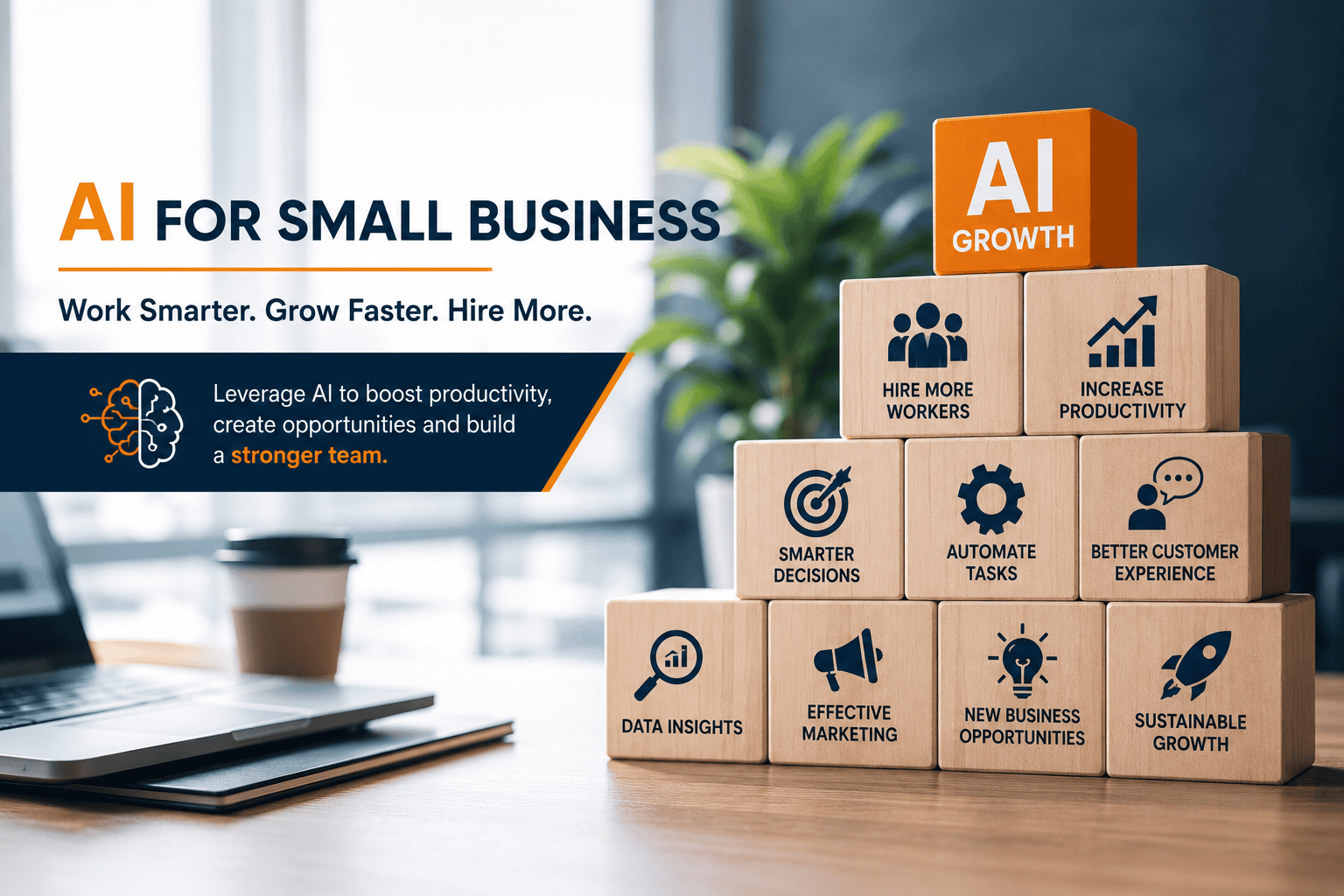
Artificial intelligence is rapidly changing the way small businesses operate, market themselves and serve customers. AI for small businesses is becoming an important growth tool, helping companies improve productivity, reach more customers and compete more effectively.
For a broader look at the technology behind this transformation, read our guide to how artificial intelligence is changing every industry.
Recent discussions before the U.S. House Small Business Committee highlighted this changing relationship between artificial intelligence and employment. Data presented by the U.S. Chamber of Commerce showed that generative AI adoption among small businesses increased significantly, reaching 58% in 2025 compared with 40% in 2024 and 23% in 2023.
Even more interesting, 82% of small businesses that reported using AI had increased their employee headcount during the previous year.
This suggests that AI does not have to be a replacement for people. Instead, AI for small business growth can help companies increase their capacity, attract more customers and create enough demand to expand their teams.
Here are 10 practical ways small businesses can use AI to grow.
1. How AI for Small Businesses Can Create New Sales Opportunities
One of the biggest advantages of AI for small businesses is its ability to make activities possible that may previously have been too expensive or time-consuming.
Many small companies struggle to invest consistently in website content, advertising, graphic design, customer research and marketing because they have limited budgets and staff.
AI can help businesses create a stronger presence without requiring a large team.
For example, small business owners can use AI to:
- Develop marketing campaigns
- Create social media content
- Research customer preferences
- Write email campaigns
- Improve product descriptions
- Generate advertising ideas
- Analyze sales information
- Identify potential customer segments
Instead of asking, “What employee can AI replace?”, entrepreneurs should ask:
“What could my business be doing today that we currently don’t have the time, money or resources to do?”
That mindset turns AI from a cost-cutting technology into a potential growth tool.
2. Start With One Specific Business Problem
Small businesses do not need to introduce AI into every department immediately.
The better approach is to start with a clear problem.
Think about the task that repeatedly wastes time, frustrates employees or creates unnecessary costs. It could be responding to common customer questions, managing documents, generating reports, researching competitors or maintaining marketing activities. For many entrepreneurs, AI for small businesses can turn these everyday problems into opportunities for greater efficiency.
Once the problem is identified, businesses can determine whether an AI solution can improve the process.
For example, a small retailer could use AI to analyze sales patterns and identify which products are performing well. A restaurant might use AI to improve inventory planning, while a consulting company could use AI to speed up research and document preparation.
Starting with one measurable problem makes it easier to determine whether the technology is actually providing a return on investment.
3. Train Employees to Use AI Effectively
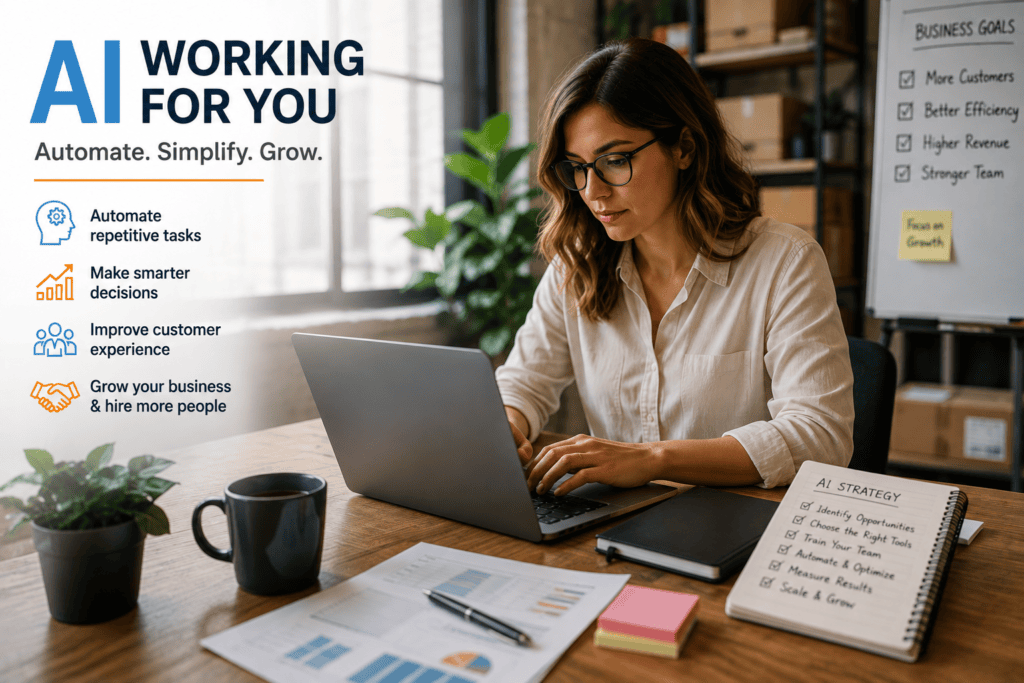
Buying AI software is only the beginning. For AI for small businesses to deliver real value, employees must know how to use these tools effectively.
Employees need to understand how to use AI correctly if a business wants to achieve meaningful results.
Companies can provide practical training on:
- Writing effective prompts
- Reviewing AI-generated information
- Automating repetitive processes
- Using AI for research
- Creating marketing content
- Analyzing business information
- Protecting confidential company data
Employees often understand day-to-day business problems better than management. Their ideas can therefore be extremely valuable when deciding where AI should be introduced.
Rather than keeping AI decisions exclusively with senior management, businesses should ask employees:
“Which part of your daily work takes the most time that AI could help with?”
The answers can reveal practical opportunities for automation and productivity improvement.
4. Use AI as a Productivity Multiplier
AI for small businesses can be particularly valuable when companies operate with limited employees, budgets and time.
This is where AI productivity tools can have a significant impact.
AI can handle repetitive activities while employees focus on tasks that require human judgment, creativity, communication and relationship-building.
For example:
Retail businesses can use AI to understand customer demand and personalize marketing.
Restaurants can use AI to improve scheduling and inventory management.
Professional service companies can use AI for research, drafting and administrative work.
Manufacturers can use AI to identify inefficiencies and reduce waste.
The goal isn’t necessarily to accomplish more with fewer employees. The bigger opportunity is to help existing employees accomplish more, allowing the business to serve more customers.
5. Automate Repetitive Back-Office Work
Administrative tasks can quietly consume hundreds of employee hours every year.
Bookkeeping, documentation, reporting, lead management, data entry and routine marketing activities can all take employees away from more valuable responsibilities.
AI for small businesses can automate repetitive back-office processes and help employees spend more time on higher-value work.
For example, AI can assist with:
- Invoice processing
- Data organization
- Lead qualification
- Email drafting
- Report creation
- Document summarization
- Basic financial administration
- Marketing workflows
Human oversight should remain important, particularly for financial, legal and customer-sensitive activities.
The objective is to reduce repetitive workload—not eliminate accountability.
6. Improve Employee Onboarding and Training With AI
Hiring someone new requires time from managers and existing employees.
AI can make the onboarding process more structured by helping companies create training guides, internal documentation, FAQs and step-by-step learning materials.
Employee training is another practical application of AI for small businesses, particularly for companies without large HR or training departments.
A company can use AI to organize its existing knowledge into an onboarding program that helps new employees understand:
- Their responsibilities
- Internal processes
- Company policies
- Software and tools
- Customer expectations
- Performance requirements
A clearer onboarding process can help employees become productive faster while reducing repetitive explanations from managers.
This is particularly useful for small companies where senior employees already have limited time.
7. Choose the Right AI Tool for the Right Task
The AI market has expanded rapidly, and businesses now have access to tools designed for different purposes.
Some platforms are better for writing and research. Others specialise in data analysis, automation, customer service, design, coding or business intelligence. Choosing the right AI for small businesses starts with identifying the specific problem the company wants to solve.
Small businesses should not select an AI platform simply because it is popular.
Instead, start with the business requirement.
Ask:
- What problem are we trying to solve?
- What type of AI capability do we need?
- Can the tool integrate with our existing systems?
- Is it easy for employees to use?
- How accurate are its results?
- How does it handle company data?
- Is the cost justified by the expected benefit?
The right small business AI tools can save time and money. Choosing the wrong platform can create additional complexity without producing meaningful results.
8. Protect Sensitive Business Information
AI can produce better results when it has access to useful context. However, that does not mean companies should upload every piece of business information into an AI platform.
As AI for small businesses becomes more widely adopted, protecting customer and company information should remain a priority.
Small businesses should be especially careful with:
- Customer information
- Employee records
- Financial information
- Passwords
- Confidential contracts
- Proprietary business strategies
- Intellectual property
Before using AI with sensitive information, business owners should review the platform’s privacy, security and data-handling policies.
Companies should also establish internal AI policies explaining what employees can and cannot enter into AI systems.
Responsible AI adoption is essential for protecting both the business and its customers.
9. Take Advantage of AI Training and Business Support
Many entrepreneurs are interested in AI but don’t know where to begin.
AI education programs, workshops, business accelerators and practical training can help small business owners understand how different technologies can be applied to their operations.
However, learning AI shouldn’t be limited to watching tutorials.
Businesses learn more effectively when employees experiment with AI on real tasks, measure the results and improve their workflows.
A simple process is:
Learn → Test → Measure → Improve → Scale
If an AI experiment saves time or increases revenue, the company can expand its use. If it doesn’t produce results, the business can adjust the approach or try a different tool.
10. Invest in Premium AI Tools When They Deliver Real Value
There are thousands of free and inexpensive AI tools available today.
For basic tasks, free solutions may be sufficient. But companies with more demanding requirements may benefit from premium AI platforms.
Paid AI tools may provide:
- Higher usage limits
- Advanced models
- Better integrations
- Enhanced automation
- Stronger security
- Specialized business features
- More reliable performance
This approach is also part of the wider shift toward digital innovation, where businesses use emerging technologies to improve efficiency and create new opportunities.
The question is whether it produces enough value to justify the investment.
For example, if a paid AI platform saves employees 30 hours every month or helps generate additional qualified leads, the cost could potentially be justified by the resulting productivity or revenue gains.
Can AI Help Small Businesses Create More Jobs?
One of the most interesting questions surrounding AI and employment is whether automation will reduce the need for workers or create new opportunities.
For small businesses, the answer may depend on how the technology is implemented.
If a company uses AI exclusively to reduce headcount, employment may decline.
But if AI is used to increase capacity, improve customer service and support expansion, the company may need more employees as demand grows.
Consider a business with 50 employees that adopts AI to automate repetitive administrative work. If those productivity gains allow the company to serve significantly more customers, it may eventually need additional salespeople, customer service representatives, managers or specialists.
In this scenario, AI isn’t replacing the workforce.
AI is helping the business grow enough to expand its workforce.
How AI Can Give Small Businesses a Competitive Advantage
Large corporations often have access to bigger marketing teams, technology departments and data resources.
AI can help reduce some of that gap.
A small business can now use affordable AI technology to perform activities that previously required multiple specialists.
This can include:
- Market research
- Content creation
- Customer analysis
- Sales support
- Marketing automation
- Data analysis
- Internal training
- Administrative assistance
That doesn’t mean AI eliminates the need for skilled professionals.
Instead, it gives small teams additional capabilities and allows employees to focus on decisions where human expertise matters most.
The Future of AI for Small Businesses
AI adoption among small businesses is likely to continue increasing as the technology becomes easier to use and more affordable.
However, successful AI adoption isn’t simply about buying the newest software.
The businesses that benefit most will be those that connect AI adoption to specific business objectives.
They will identify problems, test solutions, train employees, protect sensitive information and measure the financial impact of their AI investments.
For entrepreneurs, the most useful question may not be:
“Will AI replace my employees?”
A better question is:
“How can AI help my team serve more customers, increase productivity and grow the business?”
When used strategically, AI can become a powerful productivity multiplier for small businesses. It can reduce repetitive work, strengthen marketing, improve customer experiences and give employees more time for strategic responsibilities.
And when greater productivity leads to greater demand, AI may do something many businesses don’t expect: help create the conditions for hiring more people.
Frequently Asked Questions
How can small businesses use AI?
Small businesses can use AI for marketing, sales, customer service, research, content creation, data analysis, bookkeeping, employee training and repetitive administrative tasks.
Can AI help a small business increase sales?
Yes. AI can help businesses analyze customers, identify opportunities, personalize marketing, create content and improve sales processes. Results depend on how the technology is implemented and monitored.
What are the best AI tools for small businesses?
The best AI tool depends on the company’s specific needs. Businesses should compare tools based on features, accuracy, security, integrations, ease of use and cost.
Will AI replace small business employees?
Not necessarily. AI can automate repetitive tasks while allowing employees to focus on creative, strategic and customer-facing responsibilities. Businesses that grow through increased productivity may ultimately need to hire additional workers.
Is AI expensive for small businesses?
Many AI tools offer free or affordable plans. More advanced business solutions may require paid subscriptions, but they can be worthwhile when they save significant time or contribute to revenue growth.
How can small businesses protect data when using AI?
Businesses should review AI providers’ privacy and security policies, avoid sharing unnecessary sensitive information and establish clear internal guidelines for employees using AI.
Why should employees receive AI training?
Training helps employees use AI more effectively, identify useful automation opportunities and understand the limitations and risks of AI-generated information.
How should a small business start using AI?
Start with one specific business problem. Test an appropriate AI solution, measure the results and expand the technology only when it demonstrates clear value.







Leave a Comment