

10 Oct, 2026
Meet Sabba Keynejad: The Founder Who Turned Y Combinator Rejection Into a $40M ARR Startup
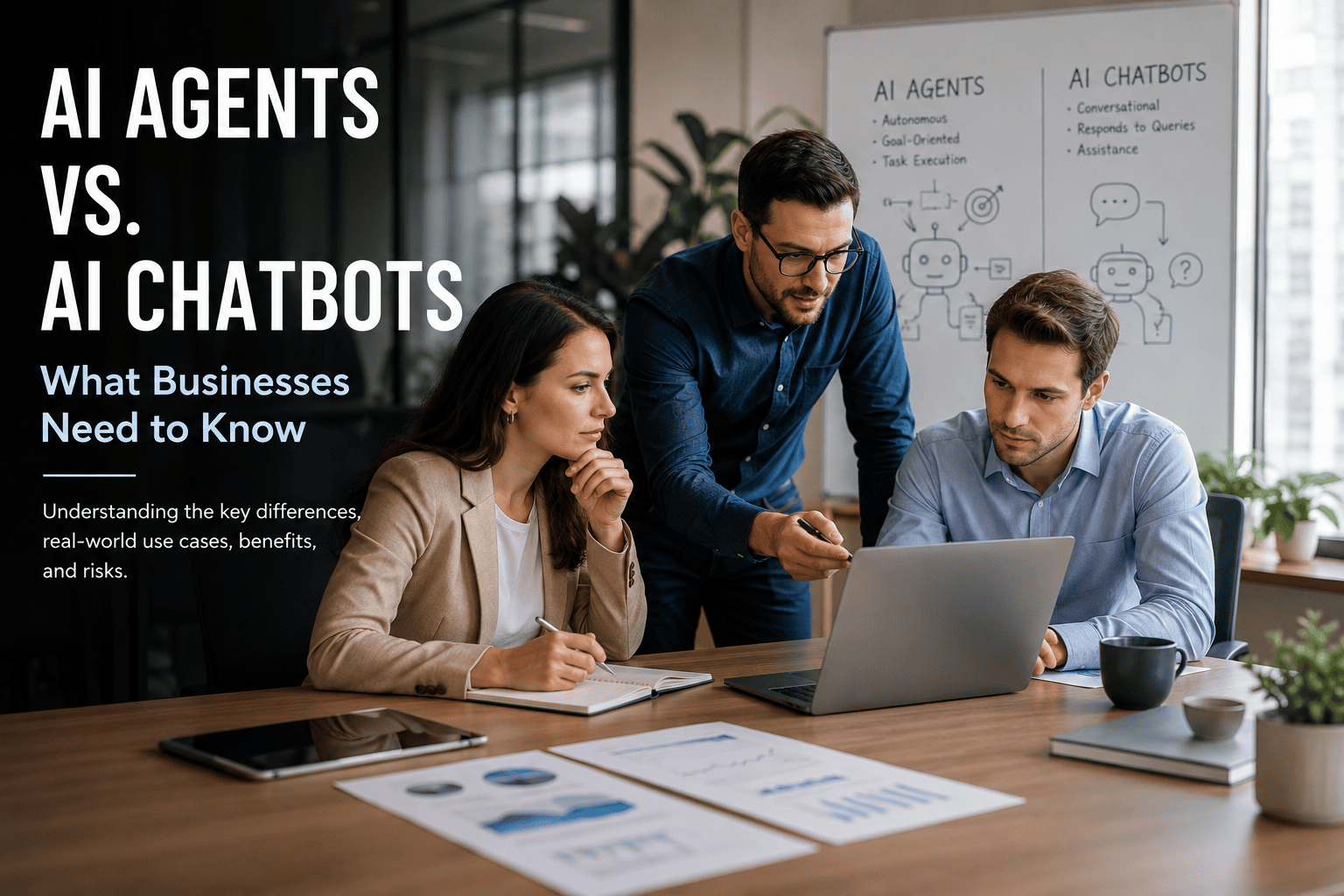
Artificial intelligence has moved far beyond simply answering questions or generating text. AI agents vs AI chatbots is becoming an important distinction as businesses look for new ways to automate tasks, improve productivity, and connect AI with everyday business processes.
AI chatbots are already widely used for customer support, content generation, information retrieval, and internal assistance. AI agents take the concept further by being designed to pursue goals, plan tasks, use tools, and take actions on behalf of users within defined boundaries.
So, what is the difference between AI agents and AI chatbots, and why are businesses increasingly interested in AI agents?
What Is an AI Chatbot?
An AI chatbot is a software system designed to communicate with users through natural language.
Modern AI chatbots can answer questions, summarize information, generate content, assist customers, and provide recommendations. They can be integrated into websites, messaging platforms, customer service systems, and internal business tools.
For example, a customer might ask:
“What is the status of my order?”
A chatbot can retrieve the relevant information and provide an answer.
Another example could be an employee asking:
“What is our annual leave policy?”
The chatbot can search its available information and explain the policy.
The key purpose of an AI chatbot is generally conversation and assistance.
Businesses are already using artificial intelligence across industries for many of these applications. For a broader look at the technology, see our guide on how artificial intelligence is changing every industry.
What Is an AI Agent?
An AI agent is designed to do more than communicate.
An AI agent can be built to understand a goal, determine the steps required, use available tools, and take actions to complete a task. Google Cloud describes AI agents as systems that use AI to pursue goals and complete tasks on behalf of users, while IBM describes them as systems capable of designing workflows and using available tools to perform tasks.
For example, instead of asking:
“What meetings do I have tomorrow?”
a user could ask an AI agent:
“Find a suitable time for a meeting with the sales team, check everyone’s calendars, schedule it, and send the invitation.”
Depending on the system and permissions available, an AI agent could perform several steps to complete that objective.
This makes AI agents particularly interesting for business automation and multi-step workflows.
AI Agents vs AI Chatbots: What Is the Difference?
The simplest way to understand the difference is this:
A chatbot primarily responds. An AI agent is designed to act toward a goal.
| Feature | AI Chatbot | AI Agent |
|---|---|---|
| Main purpose | Conversation and assistance | Goal-oriented task execution |
| Answers questions | Yes | Yes |
| Generates content | Yes | Yes |
| Uses external tools | Sometimes | Often |
| Performs multi-step tasks | Limited | Designed for it |
| Makes decisions within defined boundaries | Limited | More capable |
| Takes actions | Usually limited | Can be designed to take actions |
| Human involvement | Often higher | Can potentially be reduced |
The exact capabilities vary between products and implementations. Not every system described as an “AI agent” has the same level of autonomy.
How Do AI Agents Work?
AI agents generally combine several capabilities rather than relying only on a conversational interface.
1. Understanding the Goal
The system first interprets what the user wants to accomplish.
For example:
“Find three potential suppliers and prepare a comparison.”
The agent needs to understand that the objective involves research, selection, and comparison.
2. Planning the Task
The system can determine the steps required to reach the goal.
These could include:
- Finding relevant information
- Comparing available options
- Organizing the results
- Preparing a report
This planning ability is one of the characteristics that separates more advanced AI agents from simple question-and-answer systems.
3. Using Tools and Data
An AI agent may be connected to business software, databases, APIs, search systems, calendars, customer relationship management platforms, or other tools.
These connections allow an agent to interact with information and software outside the AI model itself. Google Cloud identifies tools, data architecture, orchestration, and runtime as important building blocks of AI agent systems.
4. Taking Action
Once the required information has been gathered, an AI agent can potentially act, depending on its permissions.
For example, it could:
- Create a report
- Update a CRM record
- Send an approved email
- Schedule a meeting
- Generate a business document
- Update a workflow
The level of autonomy depends on how the system is designed and what access it has.
5. Checking the Result
More advanced systems can evaluate whether a task was completed successfully and determine whether another step is required.
This creates a workflow that can extend beyond a single question-and-answer exchange.
Why Are Businesses Interested in AI Agents?
Businesses are constantly looking for ways to reduce repetitive work while allowing employees to focus on activities that require judgment, creativity, and human interaction.
AI agents could support this by automating parts of complex workflows.
Customer Service
An AI agent could potentially handle several stages of a customer request rather than simply answering a question.
For example, it could identify a customer’s issue, retrieve account information, check available solutions, create a support ticket, and escalate the case when human intervention is required.
Sales
Sales teams spend significant time researching prospects, updating CRM systems, preparing follow-ups, and organizing customer information.
AI agents could assist with parts of these processes, helping sales teams spend more time on conversations and relationship building.
Marketing
Marketing teams could use AI systems to support research, campaign planning, content workflows, reporting, and data analysis.
However, human review remains important, particularly for brand messaging, customer communication, and strategic decisions.
Finance
AI agents could assist with repetitive financial workflows such as gathering information, organizing documents, preparing reports, and monitoring defined processes.
Financial decisions involving significant risk should still involve appropriate human oversight.
Operations
Operations teams could use AI agents to coordinate repetitive workflows across different software systems.
This can be particularly useful when a task requires information from several systems rather than a single database.
AI Agents vs AI Chatbots: Which Is Better for Businesses?
There is no single answer.
For businesses that primarily need customer questions answered, an AI chatbot may be enough. A company that needs an AI system to coordinate several steps across different tools may benefit more from an AI agent.
The right choice depends on:
- The complexity of the task
- The number of systems involved
- The level of automation required
- Data sensitivity
- Available human oversight
- The consequences of an incorrect action
In other words, businesses should not adopt AI agents simply because they are more advanced. The technology should solve a genuine business problem.
Are AI Agents Going to Replace Employees?
This is one of the biggest questions surrounding agentic AI.
The more realistic discussion is not simply about replacing people, but about changing how work is performed.
Some repetitive tasks may become increasingly automated. At the same time, businesses will continue to need people for strategy, leadership, relationship management, creativity, accountability, and decisions involving uncertainty or significant consequences.
The organizations that benefit most may be those that learn how to combine AI capabilities with human expertise rather than treating the technology as a complete replacement for people.
What Are the Risks of AI Agents?
Greater autonomy also creates greater responsibility.
An AI chatbot that provides an incorrect answer can create a problem. An AI system that is able to take action can potentially create a much larger one.
Businesses therefore need to consider several important areas.
Data Privacy
AI systems may have access to sensitive customer, employee, financial, or business information. Companies need clear policies around what data systems can access and how that data is handled.
Incorrect Decisions
AI systems can make mistakes. An agent should not automatically be trusted with high-impact decisions simply because it can complete a task.
Security
The more systems an AI agent can access, the more important security controls become.
Businesses need to consider authentication, permissions, monitoring, and the ability to stop or reverse actions when necessary.
For a broader introduction to digital security, read our guide on what cybersecurity is and how businesses can protect their digital world.
Human Oversight
Not every task should be fully automated.
For important activities, businesses may need approval steps where a human reviews an AI-generated recommendation or action before it is executed.
The NIST AI Risk Management Framework provides organizations with a structured approach to managing AI-related risks and incorporating trustworthiness considerations into the design, development, deployment, and use of AI systems.
How Should Businesses Prepare for AI Agents?
Companies do not necessarily need to automate everything at once.
A practical starting point is to identify repetitive workflows where AI can provide measurable value.
Businesses can begin by asking:
- Which tasks consume significant employee time?
- Which processes involve repetitive decisions?
- Which workflows already use structured digital information?
- Where could automation reduce delays?
- Which tasks require human approval?
- What data and systems would an AI agent need access to?
Starting with a clearly defined workflow can make it easier to measure whether an AI implementation is actually delivering value.
Businesses should also establish clear permissions and monitoring before giving an AI system access to sensitive information or critical business systems.
The Future of AI Agents
AI agents represent an important development in the evolution of business AI.
The first wave of generative AI focused heavily on creating and communicating: writing text, answering questions, generating images, summarizing documents, and assisting users.
The next stage is increasingly focused on getting things done.
Agentic AI is designed around greater autonomy, with systems capable of planning and executing tasks rather than simply responding to individual commands.
That does not mean every business process will become autonomous. Instead, AI may increasingly operate as a layer connecting people, information, and software.
This broader shift is happening alongside advances in other emerging technologies. For example, our feature on Nipuna Wahalathanthrige and the global vision of Wings Capital Management explores emerging areas including Advanced Air Mobility, electric aviation, drone logistics, and technology-driven infrastructure.
For businesses, the opportunity lies in identifying where AI agents can genuinely improve productivity without sacrificing security, accountability, or human judgment.
AI Agents Are Moving From Conversation to Action
AI chatbots have already changed how people interact with technology. AI agents could take that relationship a step further by allowing systems to move from answering requests to completing defined tasks.
The distinction between the two will not always be clear, and capabilities will continue to evolve. What matters for businesses is understanding what the technology can actually do, where it can create value, and where human oversight remains essential.
The companies that approach AI agents strategically, rather than simply adopting them because they are the latest technology, will be better positioned to determine where automation makes sense and where human expertise remains irreplaceable.
The future of business AI may not simply be about asking better questions. It may increasingly be about giving AI better-defined goals, better tools, and the right boundaries within which to act.
Frequently Asked Questions
Are AI agents and AI chatbots the same?
No. AI chatbots primarily focus on conversation and responding to users, while AI agents are designed to pursue defined goals and can potentially use tools and take actions.
What is the main difference between AI agents and chatbots?
The main difference is their level of action and task execution. A chatbot generally responds to a user’s request, while an AI agent can be designed to plan and execute multiple steps toward a specific goal.
How can businesses use AI agents?
Businesses can use AI agents to support customer service, sales, marketing, operations, research, reporting, and other repetitive workflows, depending on the systems and permissions available.
Are AI agents safe for businesses?
AI agents can introduce risks involving privacy, security, inaccurate decisions, and unauthorized actions. Businesses should use appropriate access controls, monitoring, and human oversight, particularly for high-impact tasks.
Will AI agents replace employees?
AI agents are more likely to automate certain tasks and change how employees work than simply replace entire jobs. Human judgment, creativity, leadership, and accountability will remain important in many business functions.
What is agentic AI?
Agentic AI refers to AI systems designed to operate with a greater degree of autonomy, including the ability to plan, make decisions, and execute tasks toward defined goals.







Leave a Comment