

10 Oct, 2026
Google Ads vs Facebook Ads: Which Advertising Platform Should Your Business Choose?
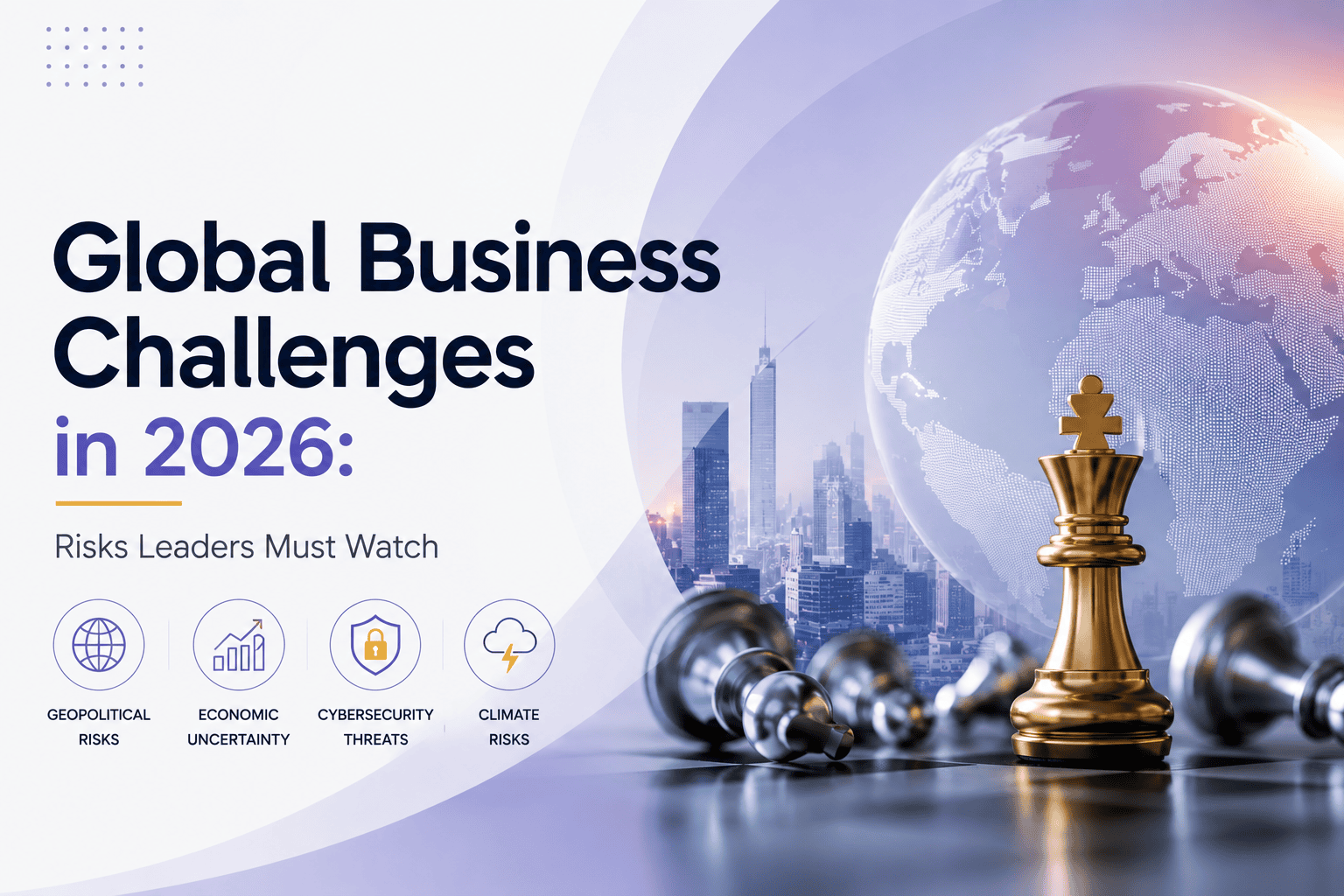
The global business environment in 2026 is being shaped by rising geopolitical tensions, economic uncertainty, technological disruption, and unexpected global crises. For business leaders, understanding these challenges and building resilience has become more important than ever.
Businesses today operate in a highly connected world where a conflict in one region, a natural disaster in another, or a sudden economic shift can impact markets, supply chains, investments, and consumer behavior worldwide.
From military tensions and trade uncertainty to climate-related disasters and evolving technology risks, the global business challenges in 2026 highlight the need for stronger leadership, strategic planning, and adaptable business models.
For executives, entrepreneurs, and organizations, the question is no longer whether disruption will happen, but how effectively they can respond when it does.
The Growing Impact of Global Uncertainty on Businesses
Global uncertainty has become one of the biggest factors influencing business decisions in 2026.
Companies are facing a combination of challenges, including:
- Geopolitical conflicts affecting international markets
- Rising operational costs
- Supply chain disruptions
- Changing consumer expectations
- Regulatory uncertainty
- Increasing pressure to adopt new technologies
The interconnected nature of modern economies means businesses cannot view risks only from a local perspective. A company operating in one country may still be affected by political decisions, economic changes, or environmental events happening thousands of miles away.
This new reality requires leaders to develop stronger risk management strategies and prepare their organizations for multiple possible scenarios.
Geopolitical Risks Are Reshaping Global Business Strategies
One of the biggest global business challenges in 2026 is the growing influence of geopolitics on commercial decisions.
International tensions, military conflicts, trade restrictions, and diplomatic disagreements are creating uncertainty for companies involved in global operations.
Businesses are increasingly reviewing:
- Where they source materials
- How they manage international partnerships
- Which markets offer long-term stability
- How they protect critical operations
Companies that previously focused mainly on cost efficiency are now placing greater importance on resilience and flexibility.
Supply chain diversification has become a major leadership priority. Many organizations are adopting strategies such as regional production, multiple supplier networks, and stronger inventory planning to reduce exposure to unexpected disruptions.
Supply Chain Disruption Remains a Major Business Concern
Supply chain challenges continue to affect industries worldwide.
From manufacturing and technology to retail and healthcare, businesses are experiencing pressure from:
- Transportation delays
- Raw material shortages
- Higher logistics expenses
- Changing trade policies
The lesson from recent global disruptions is clear: businesses cannot depend on fragile systems.
In 2026, successful organizations are investing in smarter supply chains powered by technology, data analytics, and predictive planning.
Leaders who understand their supply networks and identify potential weaknesses early will have a competitive advantage.
Natural Disasters and Climate Risks Are Increasing Business Pressure
Climate-related events are becoming a significant factor in business planning.
The United Nations has highlighted the growing importance of climate adaptation and resilience as businesses and communities face increasing environmental risks.
- Business operations
- Infrastructure
- Employee safety
- Production facilities
- Transportation networks
Recent global disasters have demonstrated how quickly communities and economies can be affected.
For businesses, climate risk is no longer only an environmental issue. It has become a financial and operational challenge.
Organizations are increasingly focusing on:
- Disaster recovery plans
- Sustainable infrastructure
- Climate adaptation strategies
- Emergency response systems
Building resilience against environmental risks is becoming a key responsibility for modern leaders.
Economic Uncertainty and Changing Market Conditions
Another major element of the global business challenges in 2026 is economic uncertainty.
According to the International Monetary Fund (IMF), global economic conditions continue to be influenced by inflation pressures, financial uncertainty, and changing market dynamics, making strategic planning more important for businesses worldwide. Businesses are navigating a complicated environment influenced by:
- Inflation pressures
- Interest rate changes
- Currency fluctuations
- Consumer spending changes
- Investment uncertainty
For companies, maintaining growth while managing costs has become a difficult balance.
Leaders are focusing on improving efficiency, controlling expenses, and identifying new revenue opportunities.
Instead of relying only on traditional growth models, successful organizations are exploring:
- Digital transformation
- New market opportunities
- Strategic partnerships
- Customer-focused innovation
Artificial Intelligence Is Creating Both Opportunities and Challenges
Technology continues to transform industries, with artificial intelligence becoming one of the biggest forces shaping business in 2026.
AI offers significant opportunities through:
- Automation
- Better decision-making
- Improved customer experiences
- Faster research and analysis
However, AI adoption also creates new challenges.
Businesses must address:
- Data security risks
- Workforce transformation
- Ethical concerns
- Employee training needs
The companies that succeed will not simply adopt AI tools. They will develop responsible AI strategies that combine technology with human creativity and leadership.
Cybersecurity Becomes a Critical Leadership Priority
As businesses become more digital, cybersecurity risks continue to increase.
Cyberattacks can damage:
- Financial systems
- Customer trust
- Company reputation
- Business continuity
For leaders, cybersecurity is no longer only an IT responsibility. It has become a strategic business priority.
Organizations are investing in:
- Stronger digital protection
- Employee cybersecurity awareness
- Data privacy systems
- Advanced monitoring solutions
A resilient business must protect both its physical operations and digital infrastructure.
Leadership Strategies for Building Business Resilience
The increasing global business challenges in 2026 require a new approach to leadership.
Successful leaders are focusing on five key strategies:
1. Building Flexible Business Models
Companies must be prepared to adapt quickly when conditions change.
Flexibility allows organizations to respond to market shifts, customer demands, and unexpected disruptions.
2. Strengthening Risk Management
Businesses need proactive risk assessment rather than reactive crisis management.
Identifying possible threats early helps leaders make better decisions.
3. Investing in Innovation
Innovation allows companies to remain competitive during uncertain times.
Organizations that continue improving their products, services, and processes are better positioned for long-term growth.
4. Developing Future-Ready Teams
Employees remain one of the strongest assets of any organization.
Companies that invest in skills development, technology training, and leadership growth create stronger foundations for the future.
5. Creating a Culture of Adaptability
Resilient companies are built by people who can adapt.
A culture that encourages learning, collaboration, and problem-solving helps businesses overcome uncertainty.
The Future of Business: Resilience Will Define Success
The biggest global business challenges in 2026 show that uncertainty has become a permanent part of the modern business environment.
Companies can no longer depend only on traditional strategies focused on growth and efficiency. They must also prioritize resilience, adaptability, and long-term thinking.
The businesses that succeed will be those led by individuals who understand global risks, embrace innovation, and prepare their organizations for change.
In a world defined by uncertainty, strong leadership will remain the most valuable competitive advantage.
Frequently Asked Questions (FAQs)
What are the biggest global business challenges in 2026?
The biggest challenges include geopolitical risks, economic uncertainty, supply chain disruptions, climate-related events, cybersecurity threats, and rapid technological changes.
How can businesses prepare for global uncertainty?
Businesses can prepare by improving risk management, diversifying supply chains, investing in technology, and building flexible operating models.
Why is business resilience important in 2026?
Business resilience helps organizations continue operating during unexpected disruptions and allows them to adapt quickly to changing market conditions.
How does artificial intelligence affect businesses in 2026?
Artificial intelligence creates opportunities for automation, innovation, and efficiency while also requiring companies to address cybersecurity, ethical, and workforce challenges.
What role does leadership play in managing business risks?
Strong leadership helps organizations identify risks, make informed decisions, support employees, and create strategies for sustainable growth.







Leave a Comment