

10 Oct, 2026
Meet Sabba Keynejad: The Founder Who Turned Y Combinator Rejection Into a $40M ARR Startup
Amazon launches new tablets today as the company takes a major step beyond its traditional budget-focused Fire tablet strategy. The new Amazon Alexa Tablet lineup brings premium hardware, Google’s Android operating system and full Google Play Store access, but the bigger development may be Alexa+, Amazon’s generative AI assistant built into every new device.
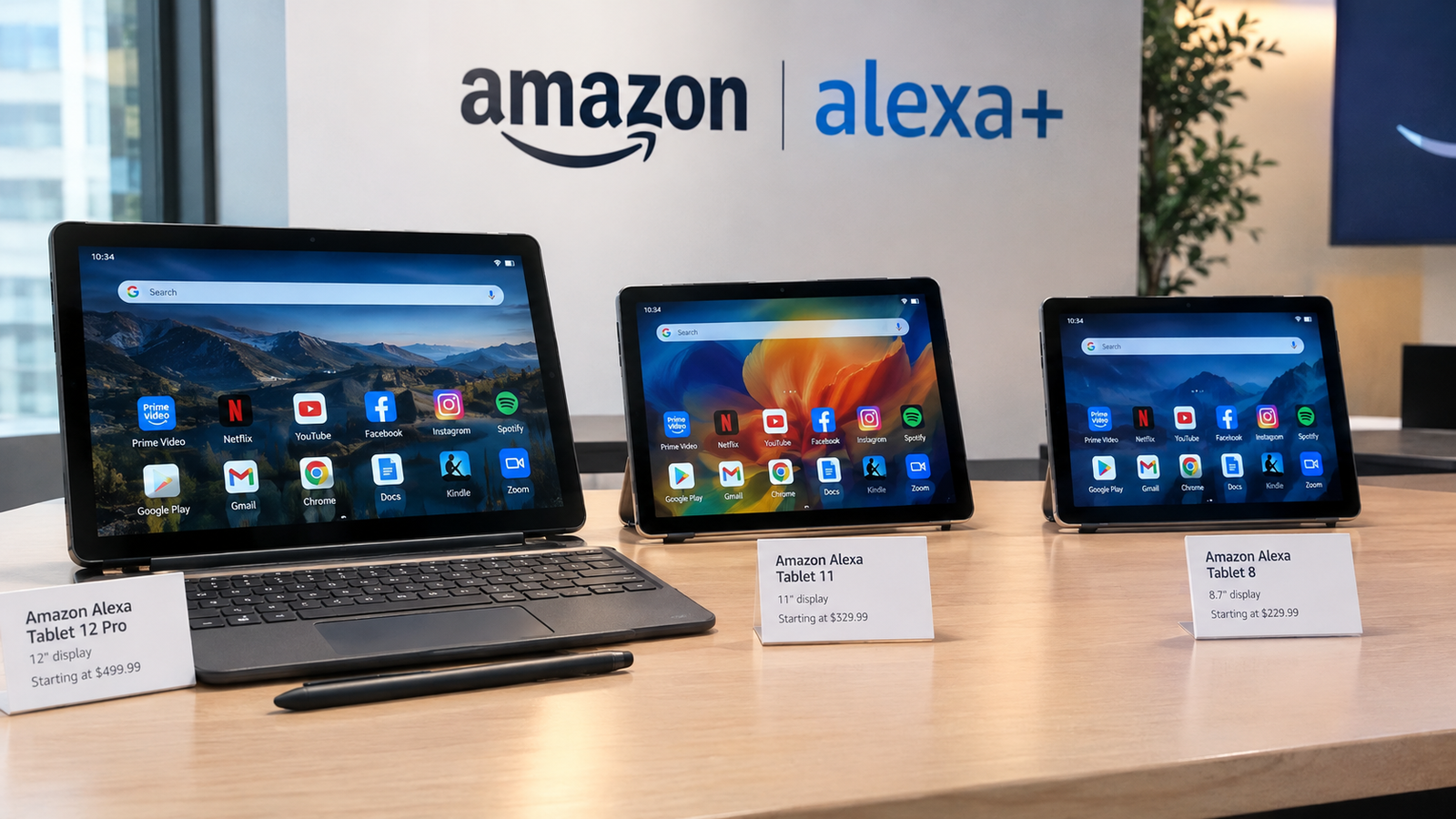
Amazon has introduced three new models: the Amazon Alexa Tablet 12 Pro, Amazon Alexa Tablet 11 and Amazon Alexa Tablet 8. Prices start at $229.99 for the 8-inch-class model, $329.99 for the 11-inch tablet and $499.99 for the 12 Pro. The devices are scheduled to go on sale October 14 in the US, Mexico and Canada, followed by several European markets on October 19.
But the hardware is only part of Amazon’s strategy.
Amazon launches new tablets with a major software shift
For years, Amazon’s Fire tablets have competed largely on affordability and access to Amazon’s entertainment ecosystem. The new lineup changes that formula.
The new tablets run Android and offer access to the full Google Play Store, giving users apps such as YouTube, Netflix, Gmail and Google Docs alongside Amazon services including Prime Video, Kindle, Audible and Amazon Music.
That move addresses one of the biggest limitations associated with Amazon’s previous tablet strategy: its more restricted app ecosystem.
The company is now positioning its tablets as more capable devices for entertainment, reading and productivity rather than simply inexpensive alternatives to premium tablets.
Alexa+ could be Amazon’s real competitive advantage
The most important feature may not be the display, processor or aluminum construction. It is Alexa+.
Amazon has built its next-generation generative AI assistant directly into all three tablets. Users can activate Alexa through voice or touch without necessarily leaving the application they are using.
Alexa+ can answer questions, provide recommendations, control compatible smart-home devices and help users complete tasks through natural conversation.
The tablets also introduce On-Screen Intelligence, allowing Alexa+ to understand information displayed on the screen when the feature is enabled.
For example, users can ask Alexa to examine information on a webpage, help compare options or work with information displayed on the tablet.
That could make the tablet less dependent on traditional app-by-app interactions.
Alexa+ turns the tablet into an AI assistant
Amazon’s larger ambition appears to be making Alexa+ an everyday digital assistant rather than simply a voice-command system.
The new tablets support live Alexa+ conversations, allowing users to continue speaking without repeating the wake word between questions. With screen-sharing features enabled, Alexa can also follow the context of what users are viewing.
Amazon says On-Screen Intelligence is off by default and requires users to opt in. A visual indicator shows when Alexa is active, while users can disable the feature through settings.
That privacy approach could become increasingly important as AI assistants gain access to more personal information and screen activity.
What the new Amazon Alexa Tablet 12 Pro offers
The flagship model is the Amazon Alexa Tablet 12 Pro, featuring a 12-inch display with a 120Hz refresh rate and 3:2 aspect ratio.
Amazon says the tablet uses a 4nm eight-core processor and can be configured with up to 16GB of RAM. The company claims it delivers nearly three times the processing performance and nine times the graphics performance of any tablet it has previously shipped.
The tablet also supports a new Pro Pen and Pro Keyboard, allowing users to turn it into a more traditional productivity machine.
A premium Nanomatte display option is designed to reduce glare while maintaining image and text clarity.
Amazon Alexa Tablet 11 and Tablet 8 target different users
The Amazon Alexa Tablet 11 is positioned as an entertainment-focused model. It features an 11-inch 2.5K display, 90Hz refresh rate, eight-core processor, 8GB RAM and Dolby Atmos speakers. Amazon rates it for up to 15 hours of video playback.
The smaller Amazon Alexa Tablet 8 focuses on portability. It features an 8.7-inch display, weighs 329 grams and offers up to 14 hours of battery life.
All three models share the same central strategy: bring Amazon’s hardware, services and AI assistant together in one device.
Amazon is moving upmarket
The launch also represents a strategic shift for Amazon.
Reuters reported that the company is moving toward higher-end tablets after years of concentrating on lower-priced Fire devices. The new products are still positioned below comparable premium offerings from Apple and Samsung, but they represent a clear move toward more expensive hardware.
For Amazon, the objective may be bigger than selling tablets.
The company has been expanding Alexa+ across its ecosystem, including televisions and mobile experiences. Putting the assistant at the center of a new tablet platform gives Amazon another environment where its AI can become part of users’ daily routines.
Alexa+ may matter more than the tablets themselves
The new tablets give Amazon a stronger hardware portfolio, but Alexa+ could ultimately determine whether the strategy succeeds.
The tablet market is crowded, with Apple and Samsung already controlling much of the premium segment. Simply offering another Android tablet may not be enough to significantly change consumer behavior.
An AI assistant that can understand what users are doing, interact naturally and complete tasks across Amazon’s ecosystem could give the company a more distinctive proposition.
That makes the Amazon Alexa Tablet launch less about another piece of hardware and more about Amazon’s broader attempt to put generative AI at the center of everyday computing.
The tablets are the product customers can buy. Alexa+ is the platform Amazon may be betting on for the future.







Leave a Comment